Is it true that inkjet printers are more environmentally friendly?
Because they use spray nozzles and a liquid that dries quickly, an inkjet device does not require a heater to fuse the toner onto the paper, unlike a laser device. This saves electricity accordingly.
Laser printer manufacturers now use high-tech toners that fix the color at very low temperatures, which has drastically reduced power consumption.
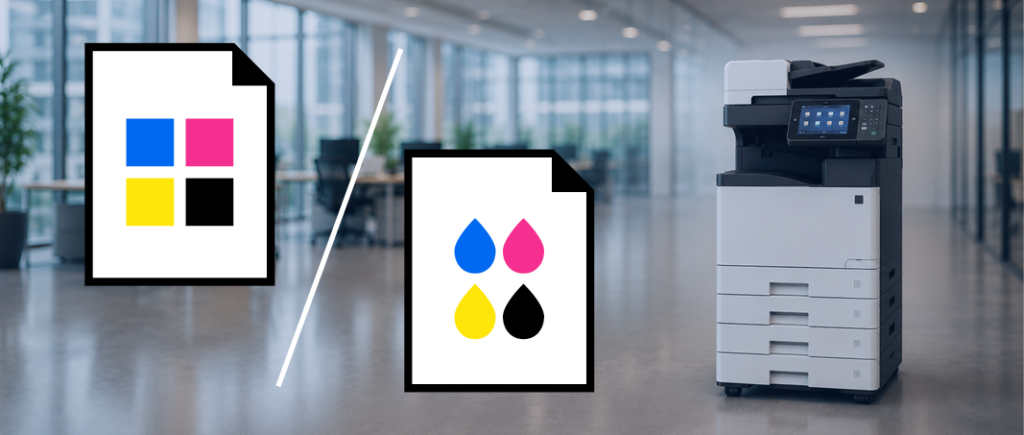
Is ink less harmful to health than toner?
The media have occasionally reported that toner, as particulate matter, is harmful to health and even carcinogenic. Ink, on the other hand, is said to be less dangerous.
It has not been established what side effects occur when ink dries. It is important to know that strict EU requirements under the REACH chemicals regulation apply in this regard and must be complied with by manufacturers. This ensures that the use of toner and ink does not endanger people or the environment.
What is the REACH chemicals regulation?
REACH is an abbreviation for Registration, Evaluation, Authorisation and Restriction of Chemicals. The European REACH chemicals regulation is intended to ensure a high level of protection for people and the environment. Under REACH, manufacturers, importers and downstream users must register their chemicals and are themselves responsible for their safe use. The registration documents are checked by the authorities for content only on a random basis. Selected substances are evaluated by the authorities and, where applicable, made subject to regulation. Substances of very high concern are subject to the authorisation procedure. REACH also provides restriction as a further regulatory option. Finally, REACH contains provisions on passing on information along the supply chain and consumers’ rights to information (e.g. in the form of a safety data sheet). Consumers can use an online form to enquire which substances of very high concern are contained in everyday products.
Source: German Environment Agency
Good to know
Neither ink nor toner is a problem when used properly. It is important to ensure that products are used which have been demonstrably tested in accordance with the REACH regulation mentioned above.
How can I ensure that the products we purchase comply with EU requirements?
Established manufacturers such as Canon, Sharp, Ricoh and HP provide the legally required safety data sheet as proof of compliance. If required, it can be obtained online from the manufacturer or supplier. Reputable manufacturers of alternative products also provide safety data sheets upon request.
What is a safety data sheet?
Safety data sheets (abbreviated SDS) are intended to provide professional users with the data and handling recommendations necessary when dealing with substances and preparations, enabling them to take the measures required to protect health, ensure workplace safety and protect the environment. They are a legally prescribed requirement.
Contents of a safety data sheet include, for example:
- Product information
- Possible hazards
- First-aid measures
- Exposure controls and personal protective equipment
- Physical and chemical properties of the product
What are the advantages and disadvantages of ink and toner?
Disadvantages of ink:
- despite all technical measures, there is a risk of drying out, which can cause the device to fail
- higher costs for individual ink cartridges
- if the device becomes defective, repair is often no longer worthwhile and a new device must be purchased
- price per page is often higher for professional use compared with toner cartridges
Advantages of ink:
- high color reproduction, especially for photo printing
- virtually no power consumption
- lower device acquisition costs
Disadvantages of toner:
- somewhat higher electricity costs during printing itself
- higher device acquisition costs
- higher toner costs
- photo prints are usually better with inkjet devices
Advantages of toner:
- the device is usually highly durable
- compared with ink cartridges, cartridges generally have a much longer yield
- toner cartridges last for several years when stored properly
- the cost per printed page is usually considerably lower than with ink cartridges
Conclusion
In practice, laser printers have clearly established themselves in everyday office life due to their high performance. In private households, on the other hand, inkjet printers are used for small print volumes and mostly photo printing, as well as because of their low device costs.
Frequently asked questions
What is the difference between ink and toner?
Inkjet printers use liquid ink, while laser printers use toner powder.
Which printer is faster—an inkjet or a laser printer?
Laser printers are usually faster for larger print jobs and are well-suited for printing many pages in a row.
Are inkjet printers unsuitable for businesses?
Not necessarily. They can be quite useful for certain applications, small print volumes, or high-quality color prints.